Procurement Apps

Zip
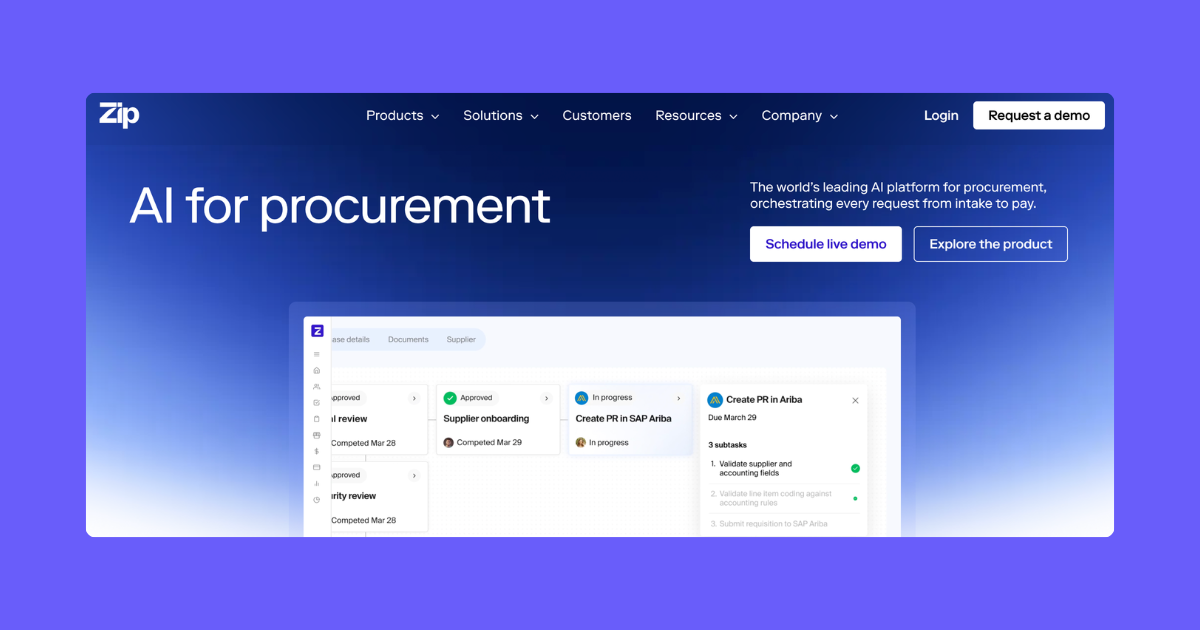
A modern intake-to-pay procurement platform built to close the mid-market gap left by legacy enterprise suites.
A modern intake-to-pay procurement platform built to close the mid-market gap left by legacy enterprise suites.
Zip, sometimes referred to as ZipHQ, is a procurement platform built specifically around intake-to-pay: the front door where employees request goods or services, routed through approvals and on to purchase. It positions itself as the modern answer to legacy enterprise suites like SAP Ariba and Coupa, with a meaningfully cleaner UI/UX and a rollout measured in a fraction of the time those platforms typically take, weeks rather than six months or longer. Practitioners generally describe Zip as solid at the specific job of intake and approval routing, flexible enough to change workflows out of the box as a company's needs evolve, without turning the rollout into a full IT project. It's also part of the newer wave of procurement tools leaning on AI as an assistant across sourcing, contract management, and compliance, though that push hasn't been received evenly: some long-time users report that a recent AI-focused update made the platform feel slower and less intuitive than before, and a few practitioners describe the shift as adding AI for its own sake rather than solving a specific problem, a pattern some tech-savvy teams have found genuinely rocky to work through.
Zip fits companies whose main procurement pain is unmanaged SaaS purchases, service requests, and complex approval chains that need a clear audit trail for finance, without wanting to take on a legacy enterprise suite's implementation lift. It's a better fit for workflow and intake problems than for deep sourcing work: companies with real eSourcing or RFP needs are generally better served by a specialist tool rather than treating Zip as a one-stop replacement, and the same is true for vendor risk and onboarding, where dedicated platforms tend to handle security reviews and compliance documentation more thoroughly. Zip is also a weaker fit for companies already running a robust ERP like NetSuite, since the native P2P functionality already in that ERP can offer comparable auditability and three-way matching at a fraction of the cost of layering Zip on top. And despite being positioned as mid-market, its pricing can still land out of reach for a company budgeting in the $25k–$50k range.
| Feature | Supported | Notes |
|---|---|---|
| Requisition & Intake | Yes | Widely regarded as the platform's core strength — a clear front door for employee requests. |
| Approval Routing | Yes | Routes requests through the right departments with a clear audit trail for finance. |
| Workflow Flexibility | Yes | Workflows can be changed out of the box as needs evolve, without a heavy IT lift. |
| UI/UX | Yes | Consistently cited as a meaningful step up from legacy suites like Coupa, SAP Ariba, and Jaggaer. |
| AI Assistance | Yes | AI is positioned across sourcing, contracts, and compliance, but a recent AI-heavy update has drawn mixed reactions from long-time users. |
| eSourcing / RFP Management | Limited | Zip is a workflow and intake tool first; deep sourcing needs are usually better served by a specialist platform. |
| Vendor Risk & Onboarding | Limited | Practitioners suggest pairing Zip with a dedicated tool for security review and compliance documentation. |
| ERP Integration | Yes | Integrates with existing ERPs, though the value proposition weakens if your ERP already has strong native P2P. |
| Implementation Time | Yes | Commonly cited as quick relative to legacy suites — weeks rather than six-plus months. |
Here are the top pros and cons for Zip based on real-user feedback from verified reviews.
Zip is priced as a modern mid-market alternative to legacy suites, but that doesn't automatically mean affordable — some practitioners specifically note that a $25k–$50k budget may still fall short of what Zip costs, which is worth confirming directly before assuming it fits a smaller company's range.









Zip manages the intake-to-pay process — acting as the front door where employees request goods or services, routing those requests through approvals with a clear audit trail for finance.
Not primarily. Zip is built as a workflow and intake tool. Companies with deep, ongoing eSourcing or RFP needs are generally better served by a specialist sourcing platform alongside or instead of Zip.
Zip is consistently described as faster to implement and more intuitive to use day to day, with rollout measured in weeks rather than the six-plus months legacy suites often require. The trade-off is depth — Zip covers intake and approvals well but isn't a full source-to-pay suite the way Coupa or Ariba aim to be.
It's genuinely mixed. Some see the AI push across sourcing, contracts, and compliance as a meaningful step forward, but a number of long-time users report the update made the platform feel slower and less intuitive, with some describing it as adding AI without a clear problem it solves.
Zeiv covers the same core intake-to-approval gap, purchase requests, category-specific approvals, PO issuance, and invoice pre-approval, without pricing that assumes a mid-market budget well above $25k–$50k.